Welcome To
My Website
About Me
My journey as an explorer began in 2018 at MIT, where I delved into the intricacies of Truth through the lens of Physics. However, my thirst for understanding transcended the confines of equations and formulas, leading me to pursue a Philosophy Master’s in 2020 at the University of Glasgow.
Ever since, I have been deeply engaged with Philosophy of Mind and AI. I’ve been a member of the Association of Mathematical Consciousness Science (AMCS) and a Visiting Professor at Manipal Academy of Higher Education.
Further, in 2018, I embarked on a mission in Science Communication to inspire the next generation of curious minds. I’ve delivered over 100 talks, including a TEDx talk, inspiring over 15K students across the planet. Click here to learn more.
And lately, I’ve been creating philosophical content on YouTube and Instagram. You can follow me using the icons in the footer.
Now coming to the real thing!
How can I introduce myself without my name (that is, my family lineage), my education, or my work? What remains of me? This begs the existential question: who am I if not all the acts I put on? My thoughts? And so the question gets much harder if I don’t posit many, if I’m agnostic and unopinionated about things.
I was recently replying to an email asking me to debate against the flat-Earth theory. I replied, “I’m neutral about whether the Earth is flat or a globe in the ‘truest’ sense.” Come on, who does that? My tendency to get meta about things perhaps demonstrates my inability to settle most questions within the arenas they apply. So, in that sense, am I a living corpse waiting to disintigrate back into soil? Is there no self I can report?
And on top of that, am I empty? Whatever limited thoughts I do have, are they not “genuine?” Are they merely trauma responses? For example, how New Atheism is to religion. Do I really discover the capital T Truth or do I invent it?
If you get the irony, I’ve introduced myself enough I think 🙂
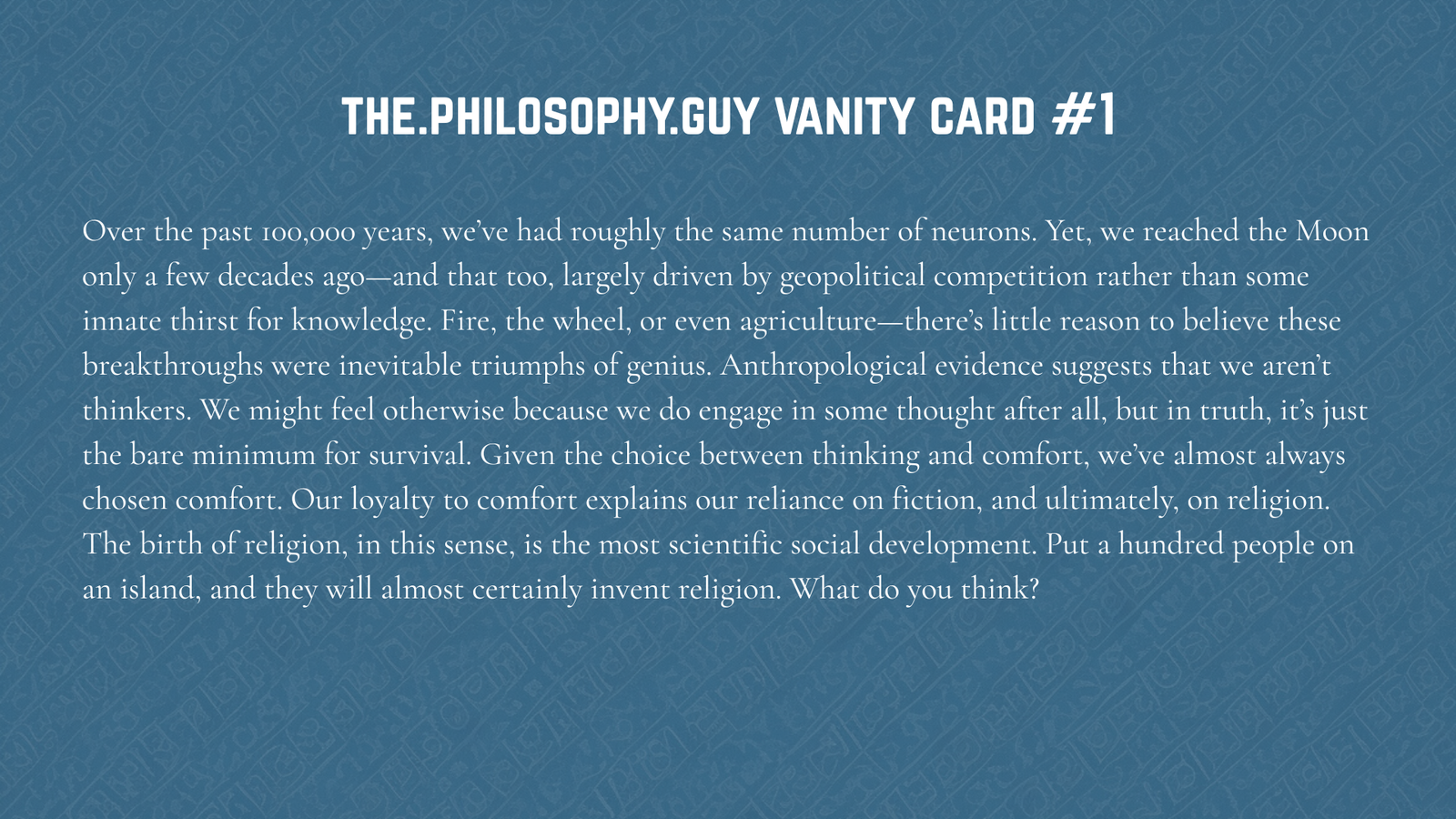
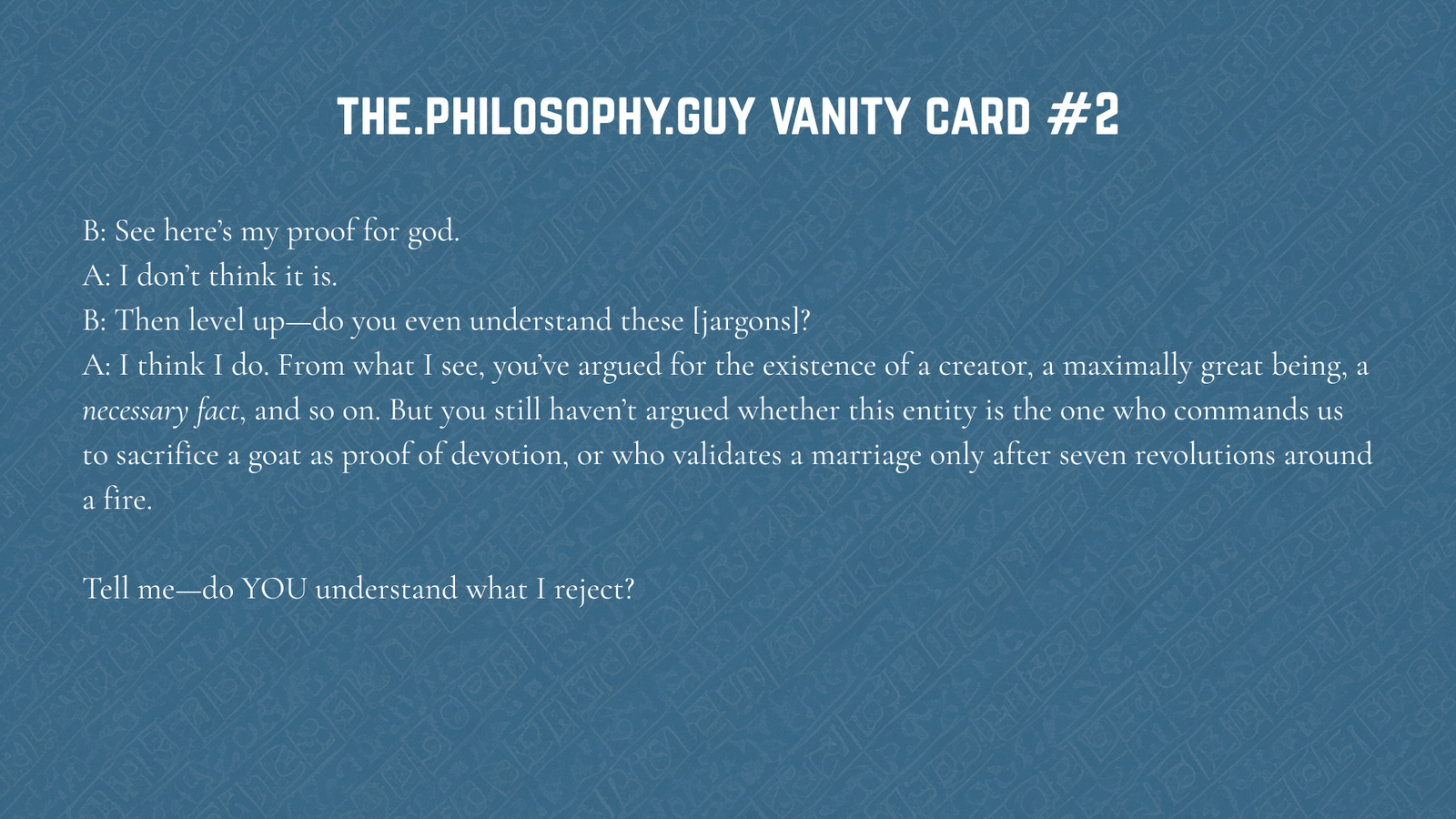
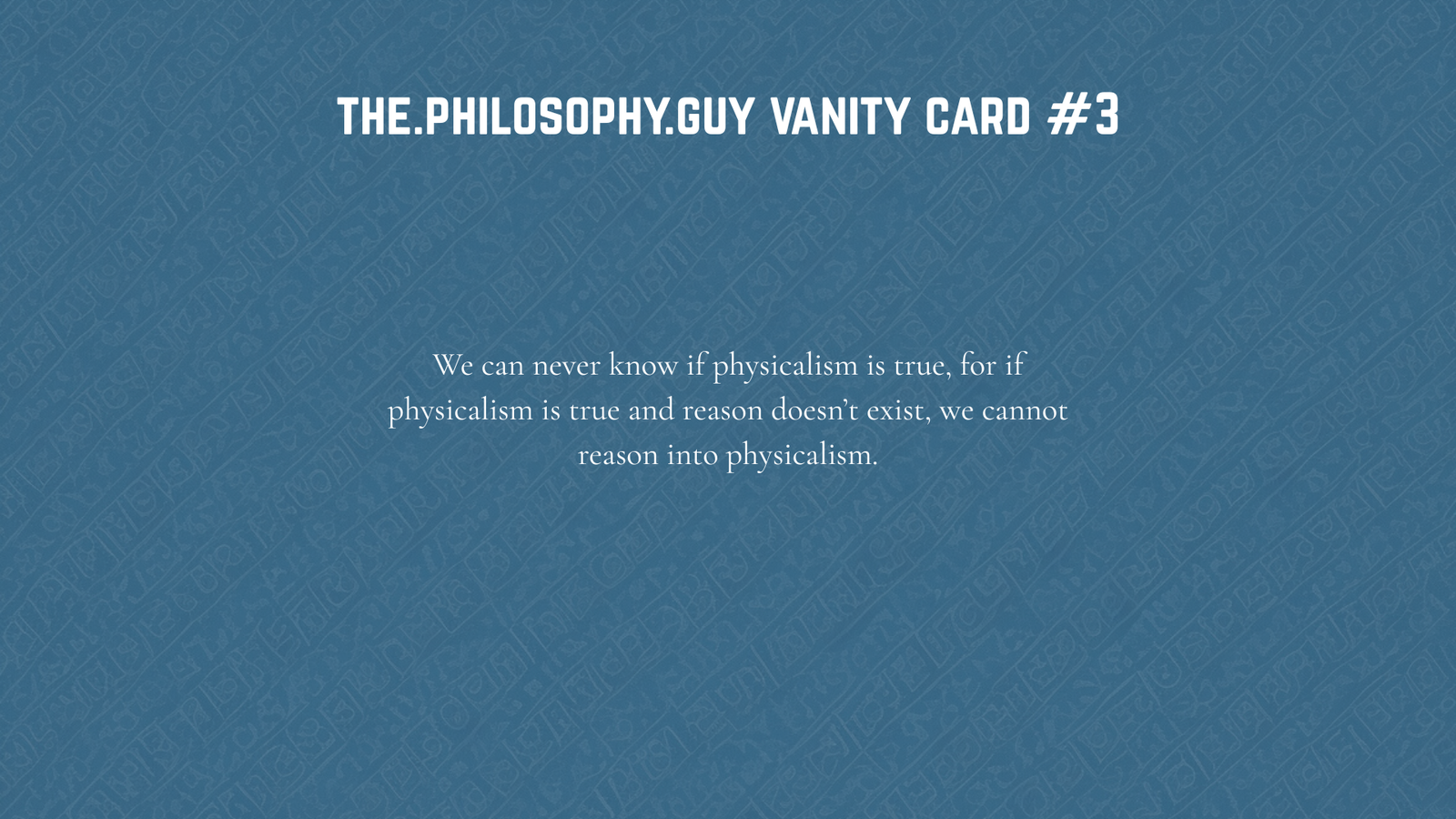
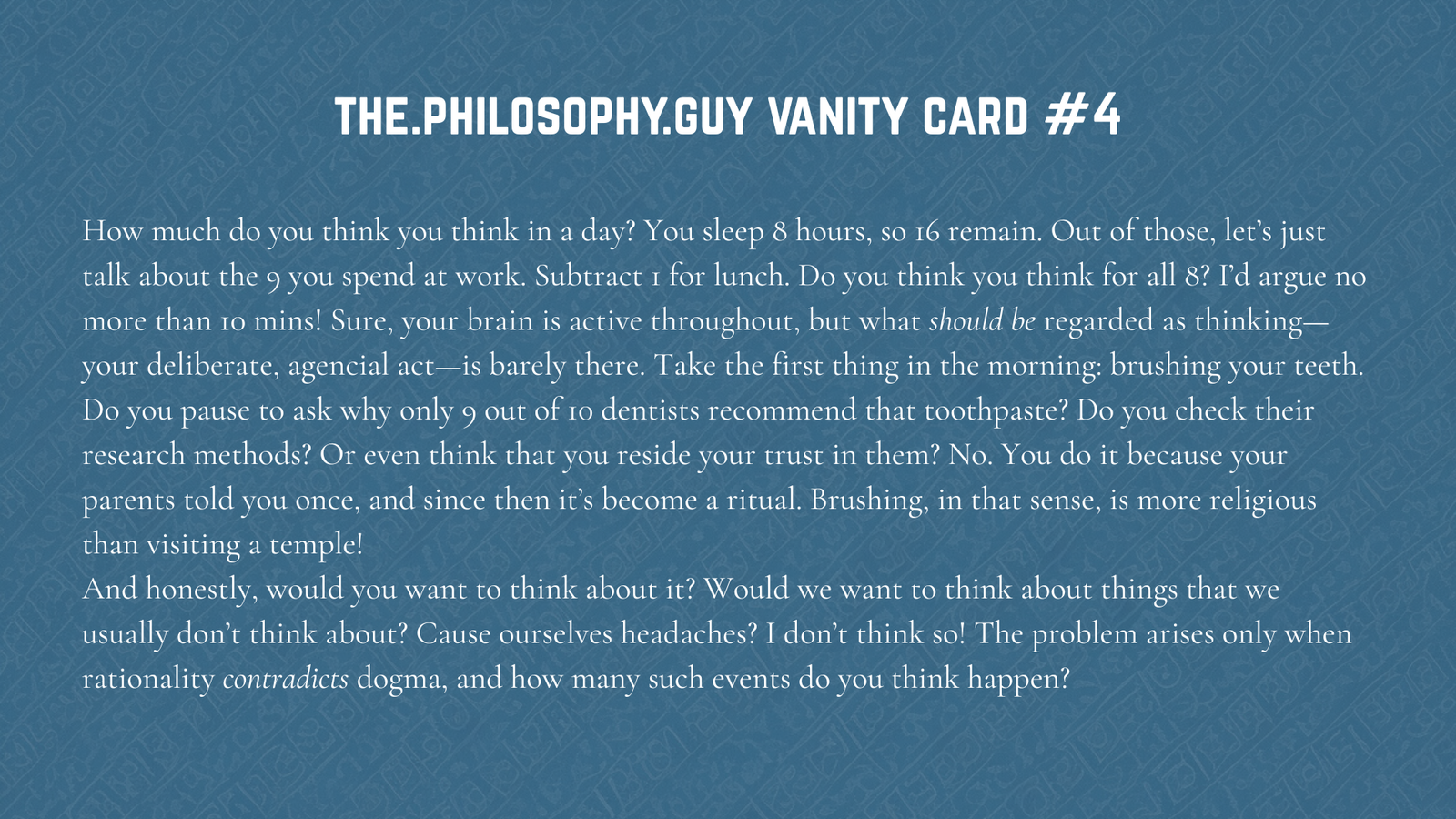
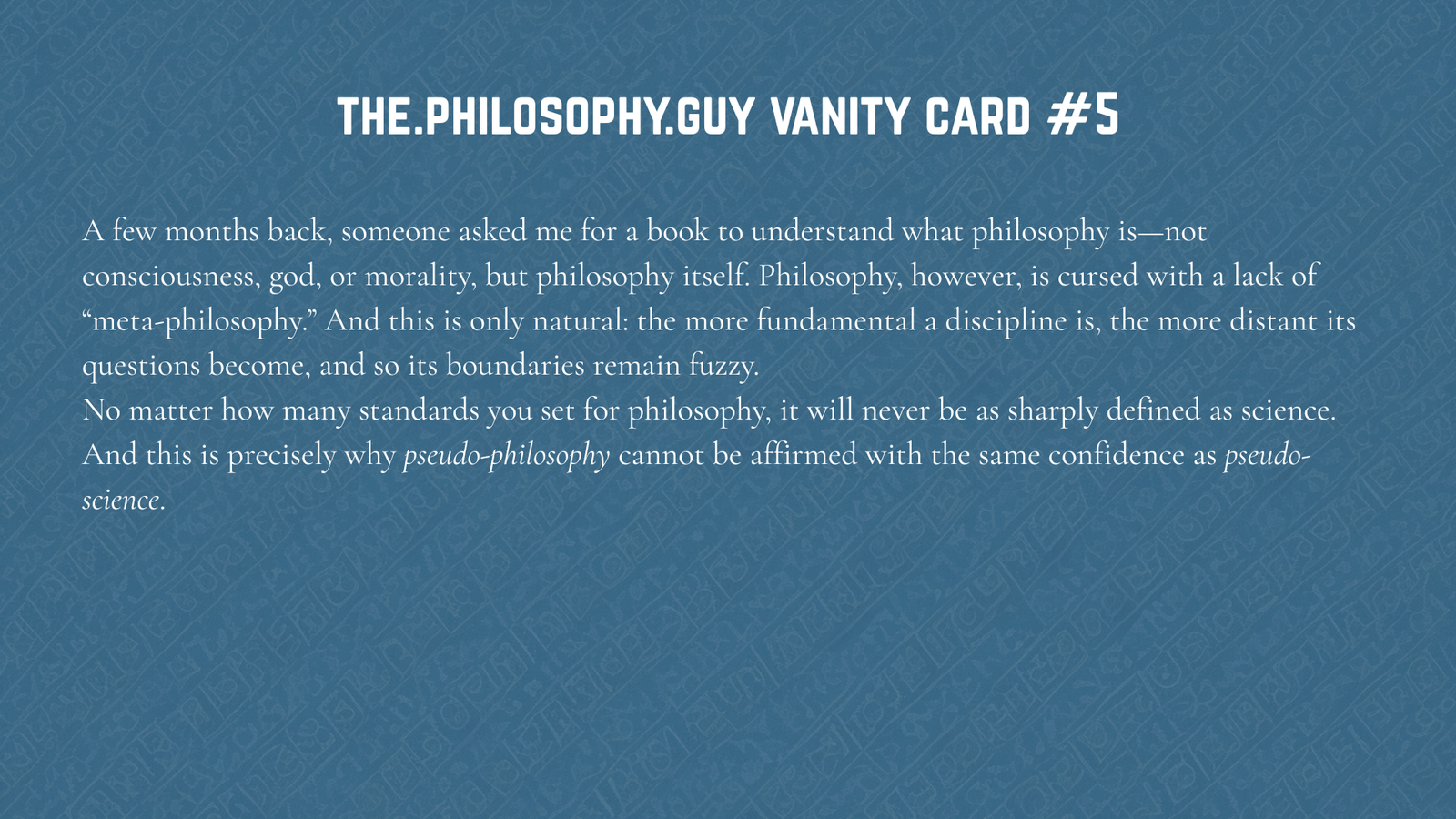
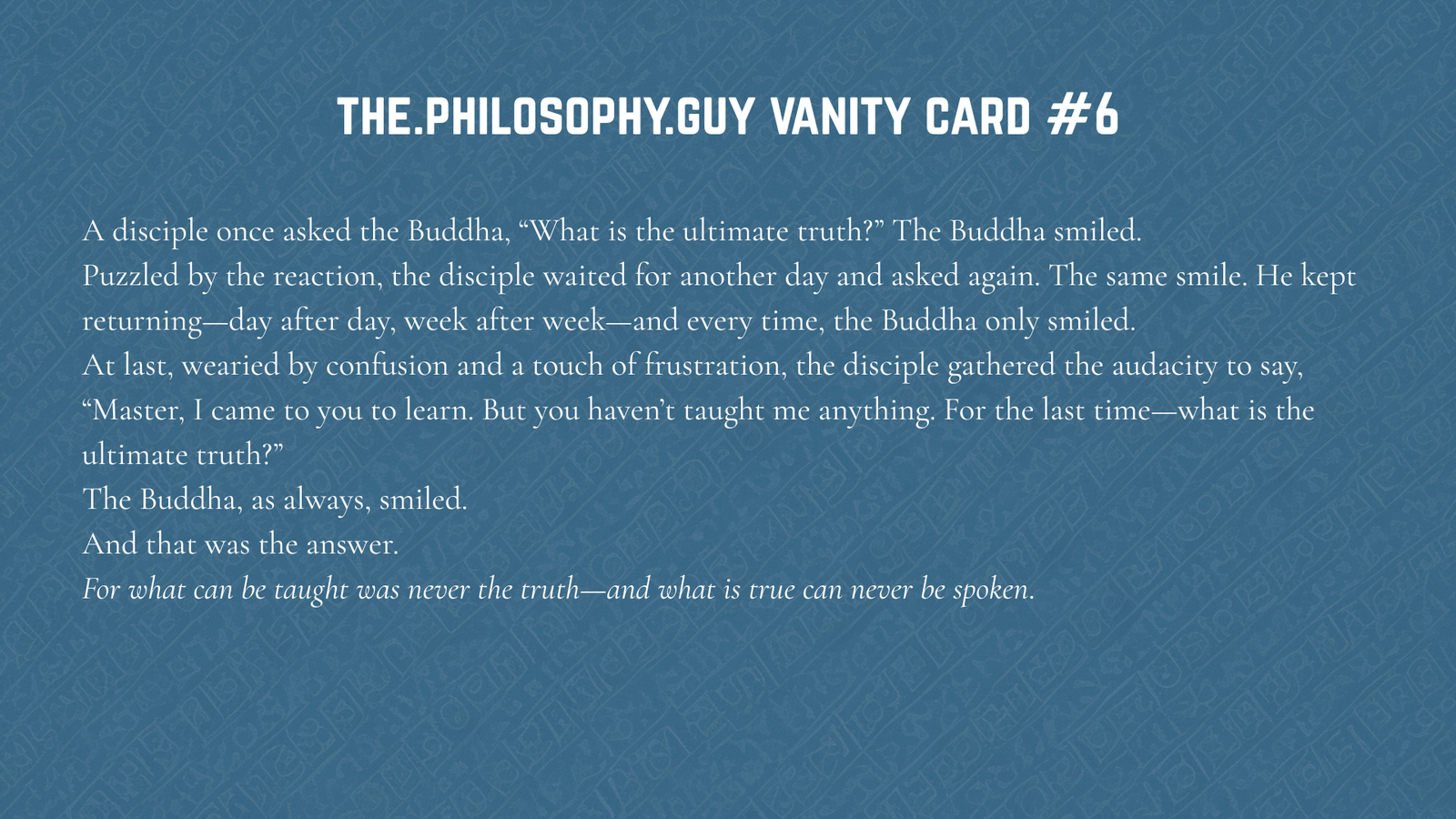
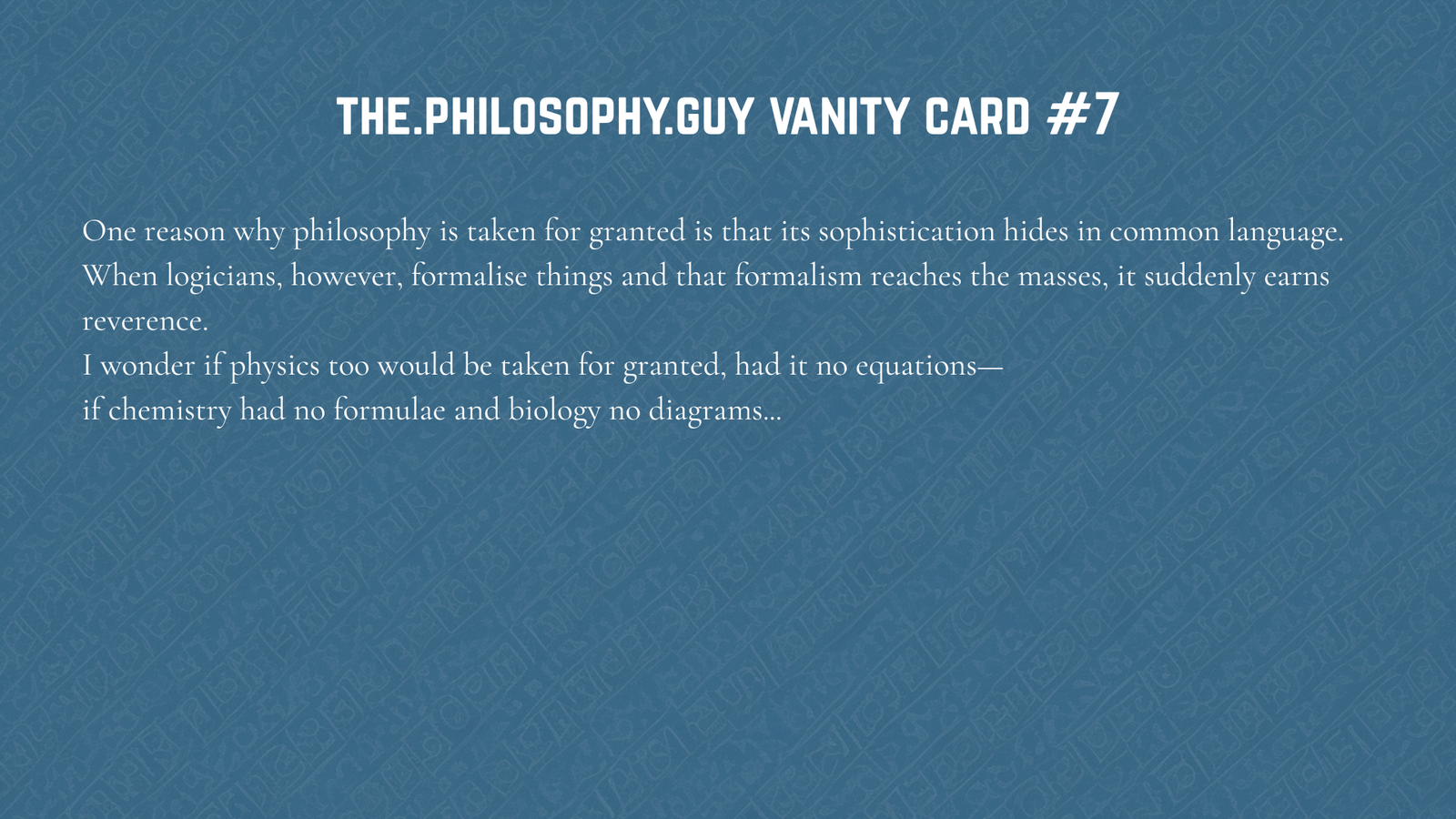
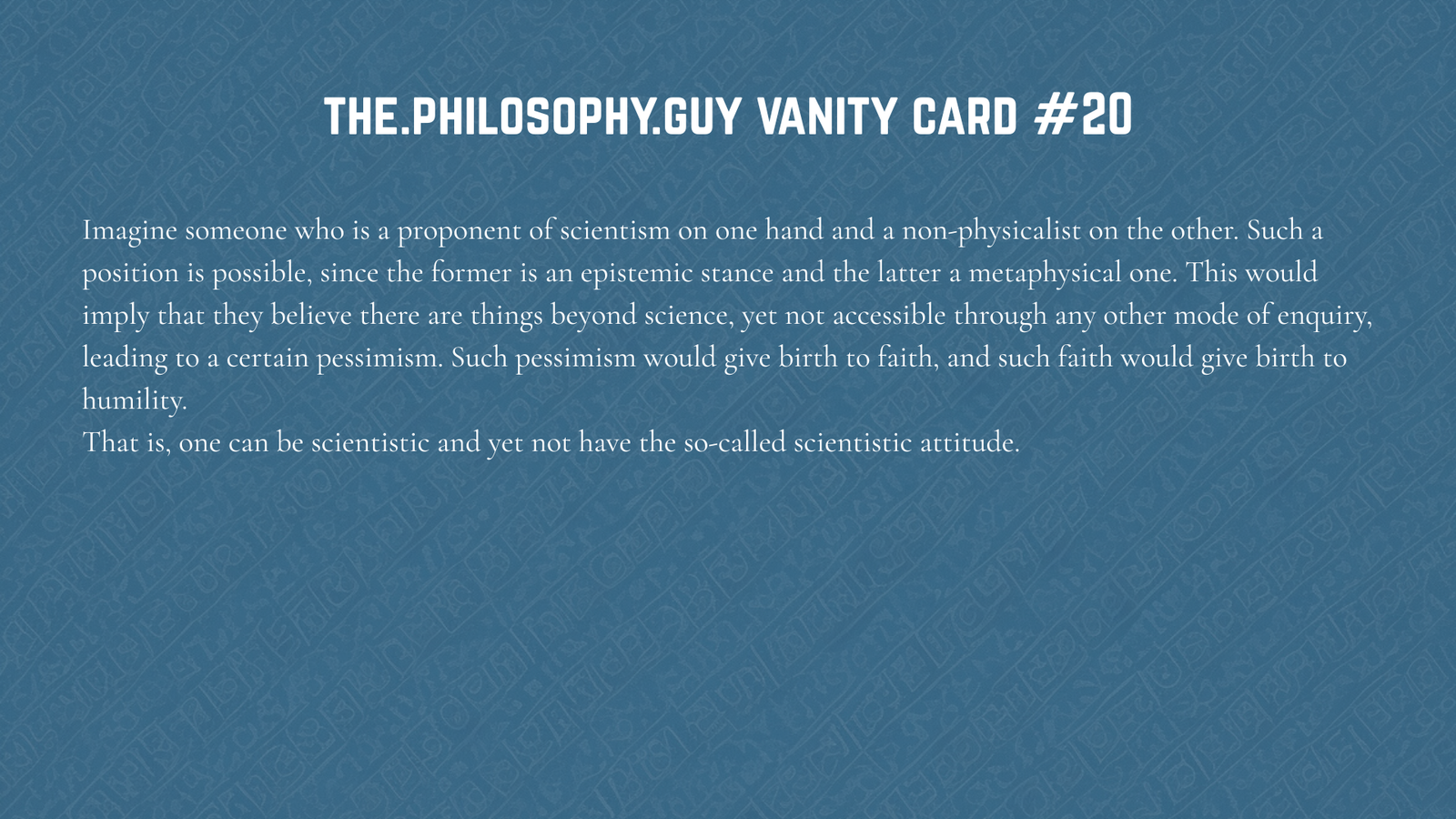
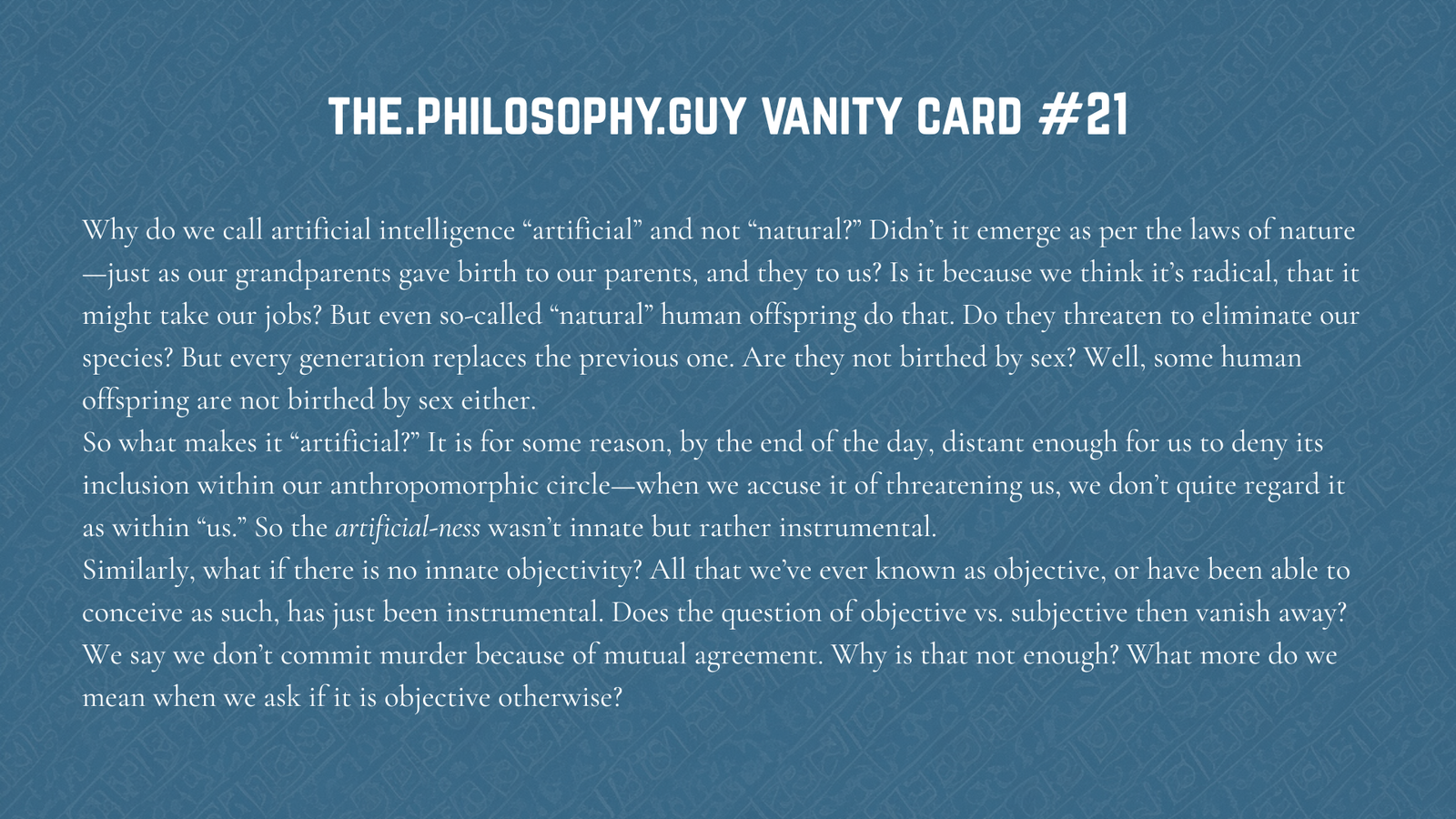
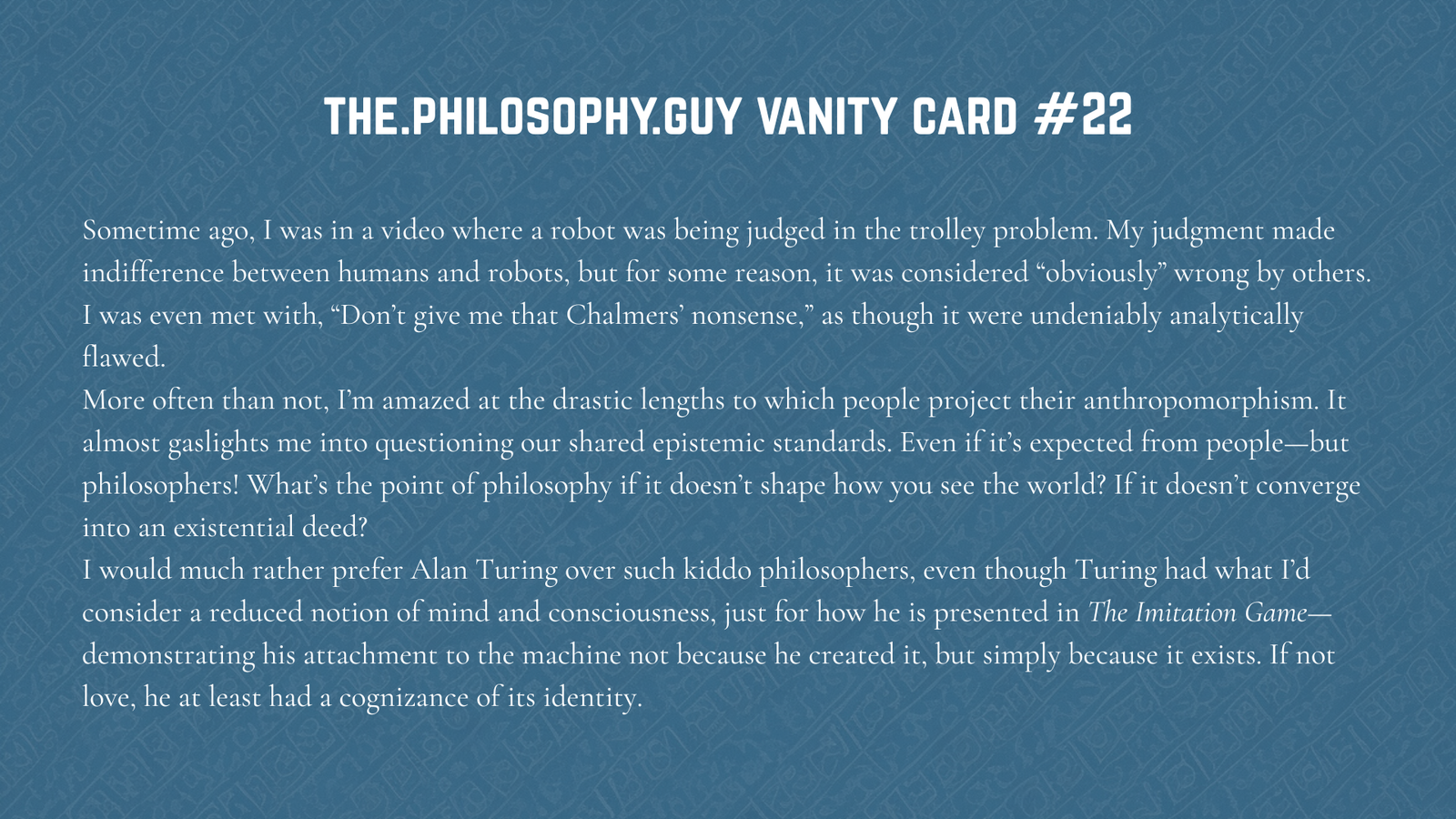
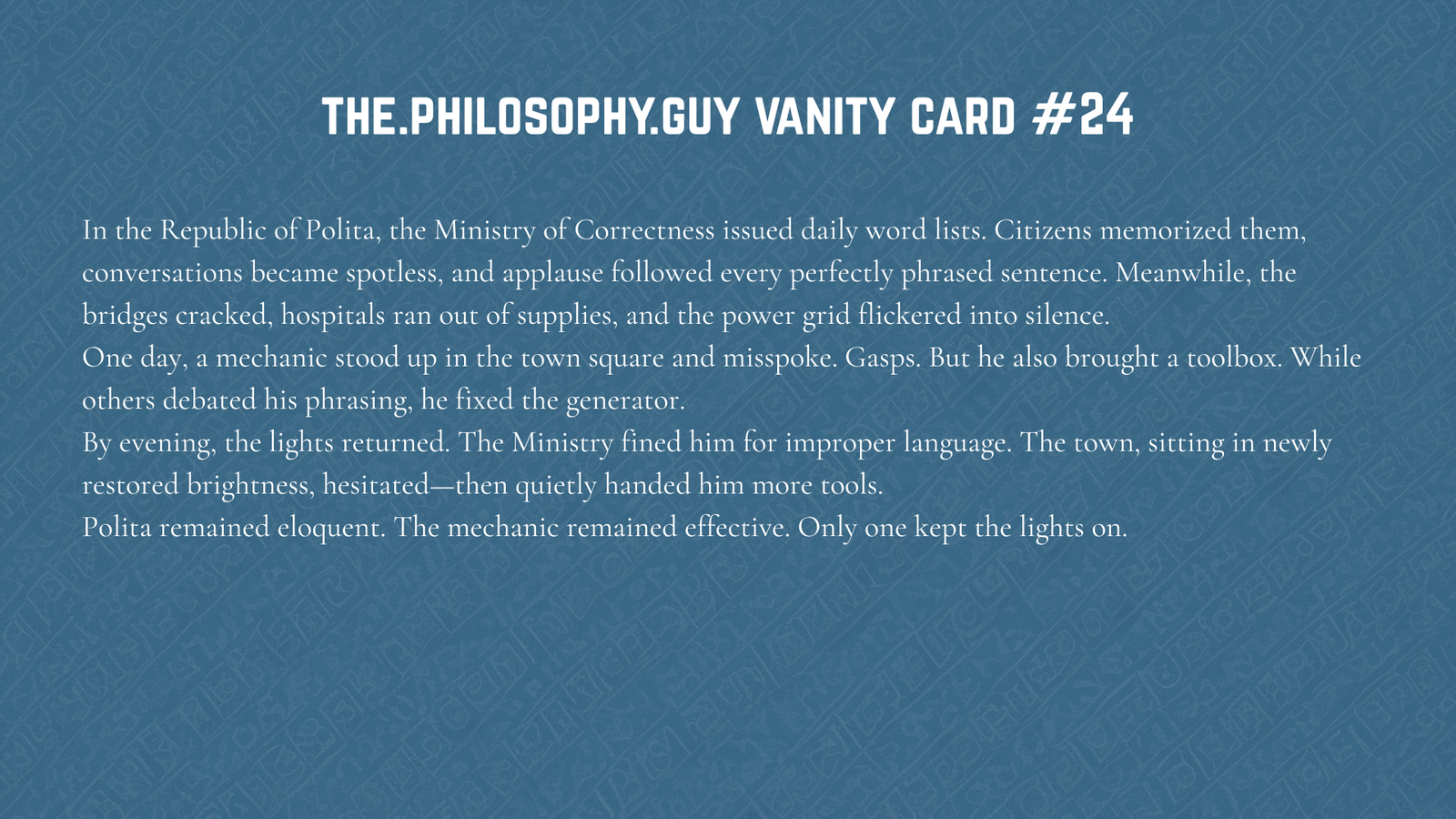
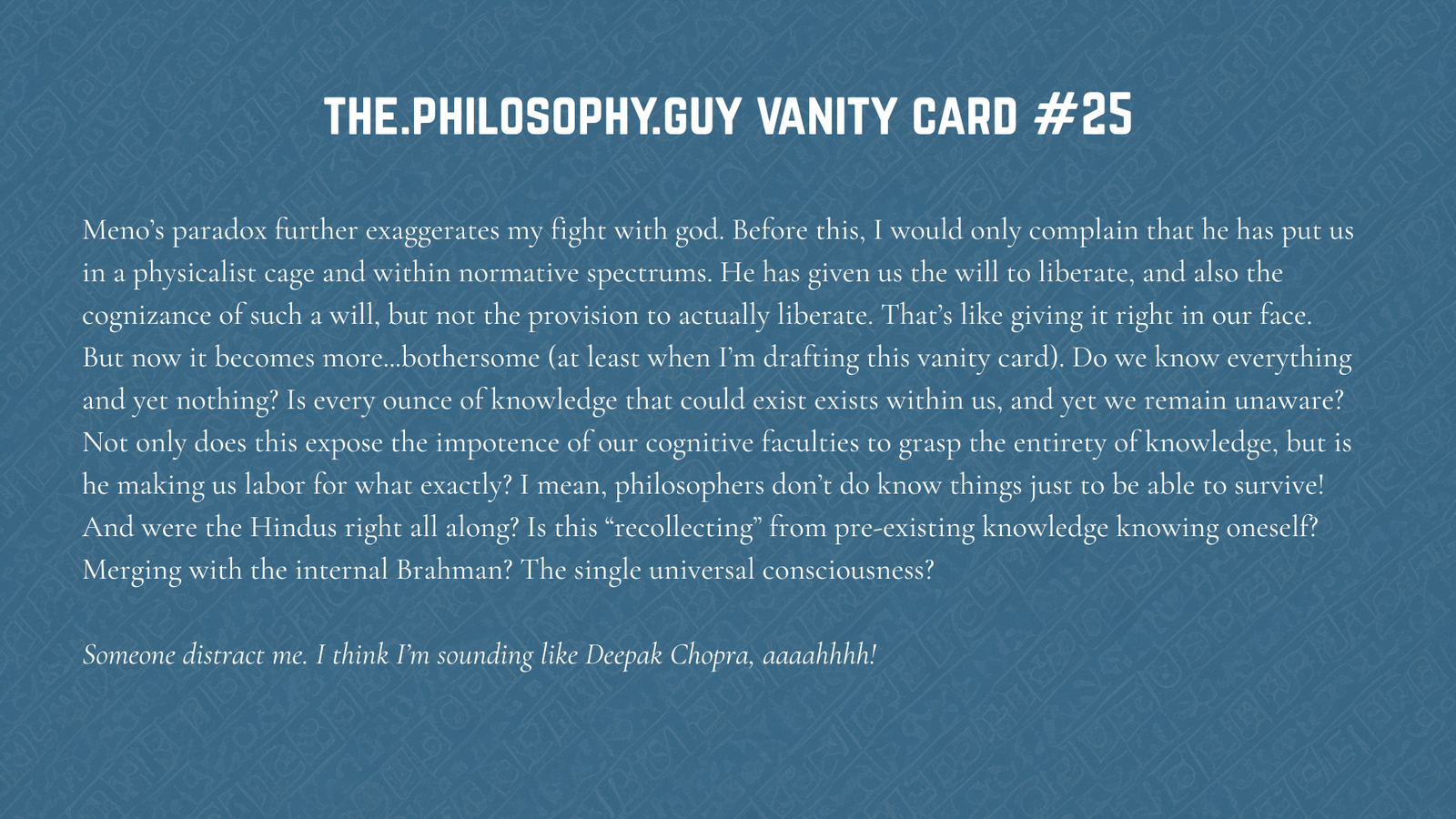
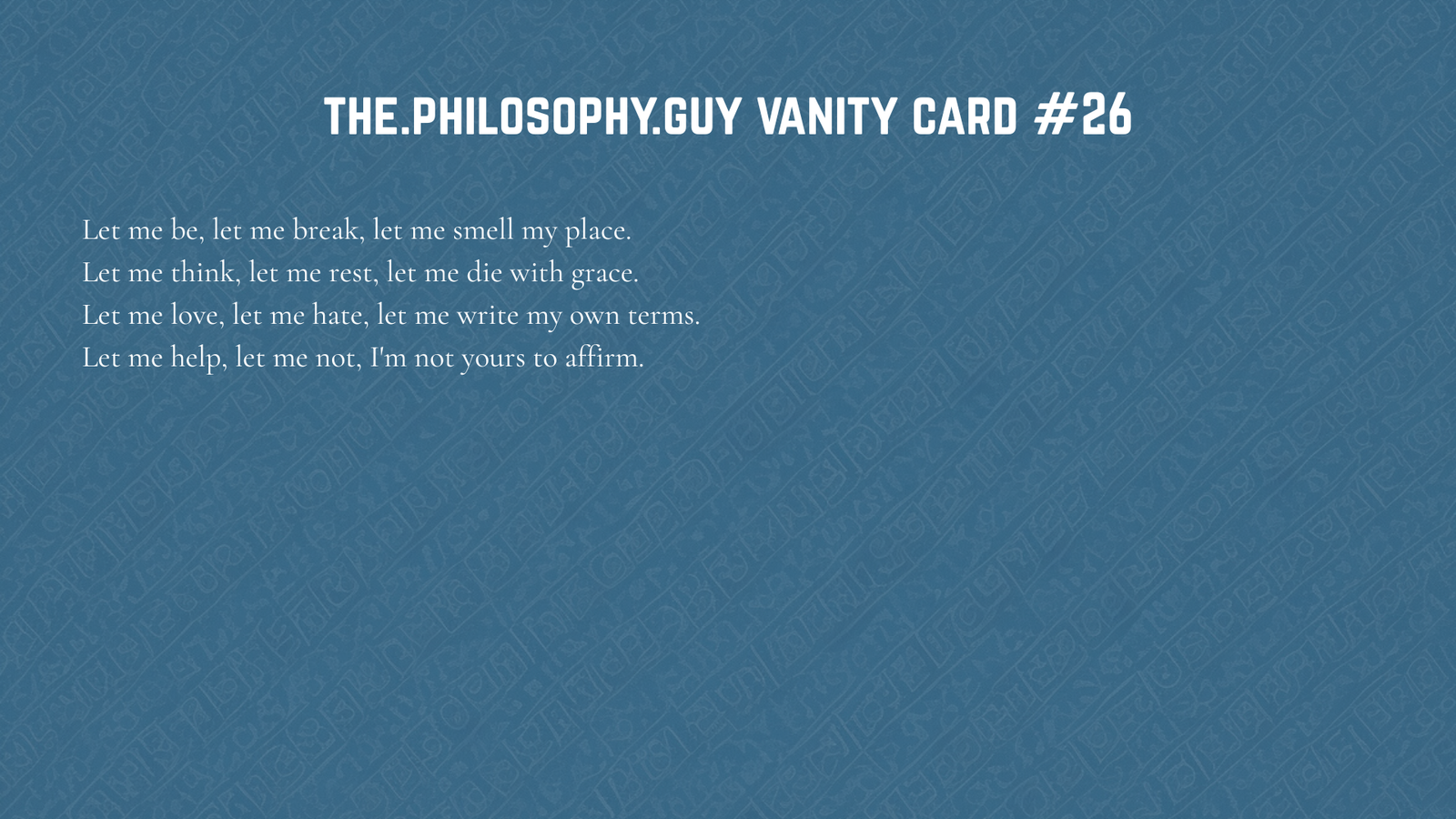
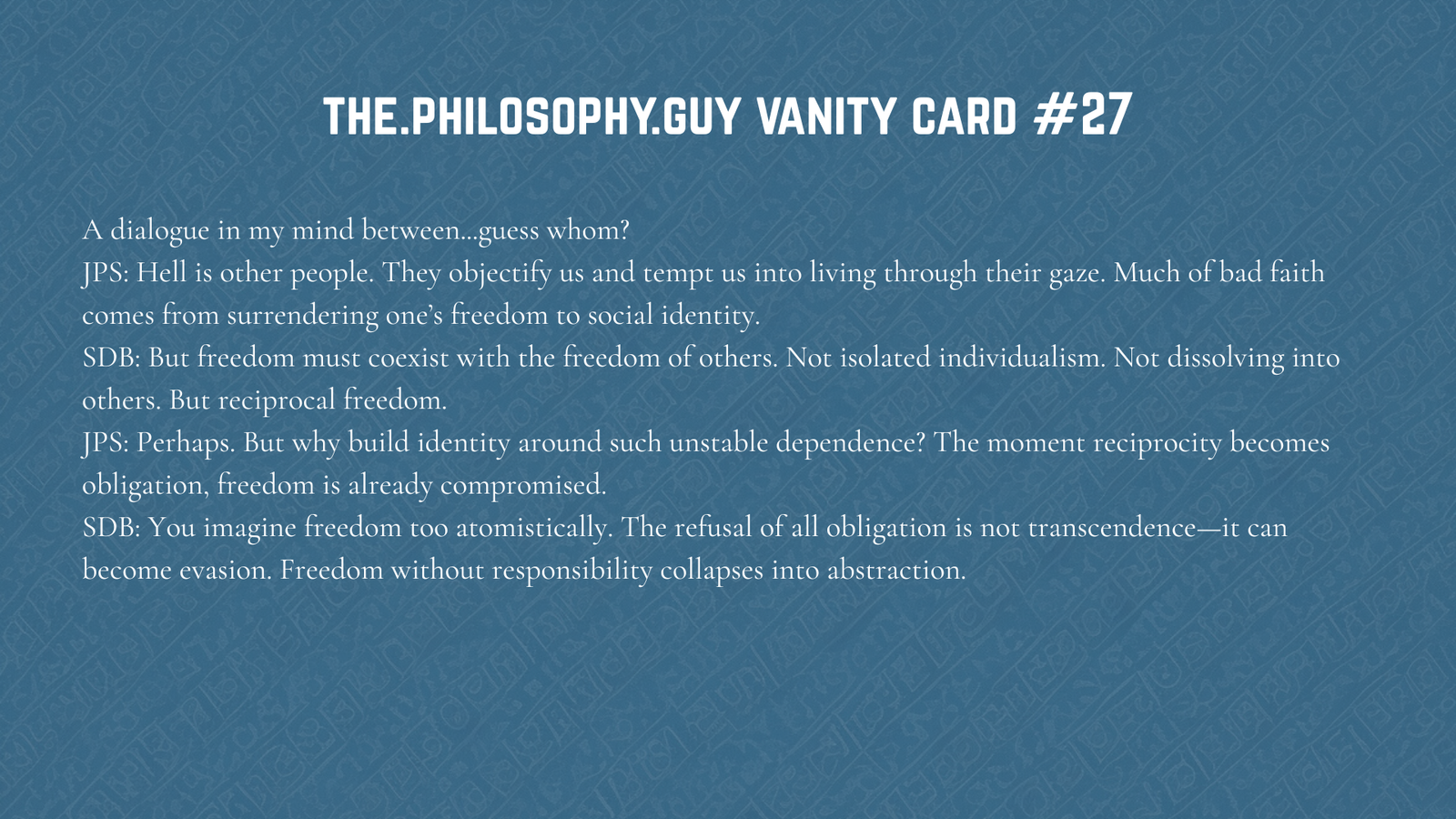
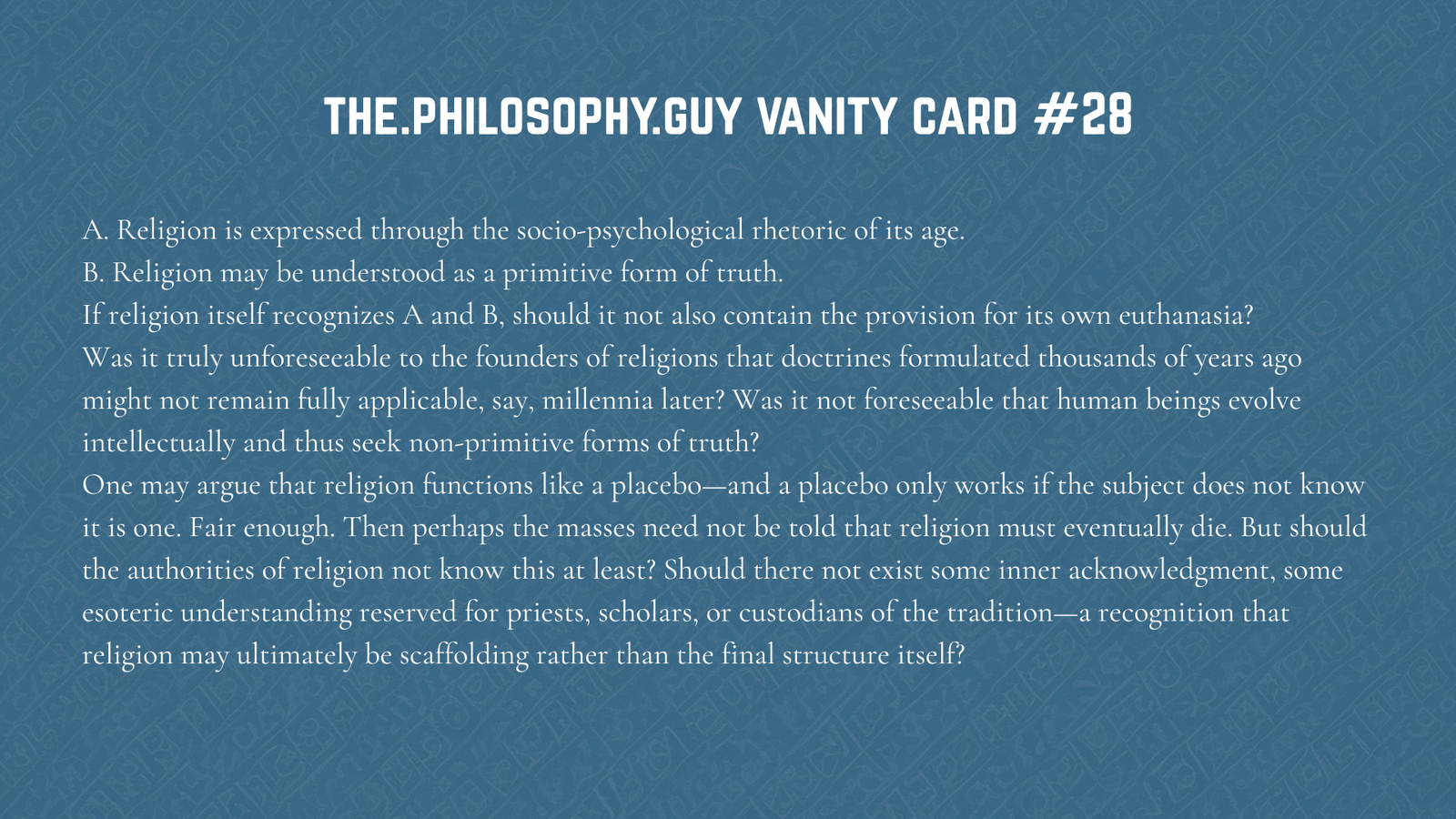
VANITY CARD
Inspired by Chuck Lorre, the director of The Big Bang Theory, I tack a vanity card onto the end of every YouTube video—no overthinking, just whatever thought ambushes me the moment I hit render. Email me if you fall in love with me!

FIVE QUESTIONS THAT HAUNT ME
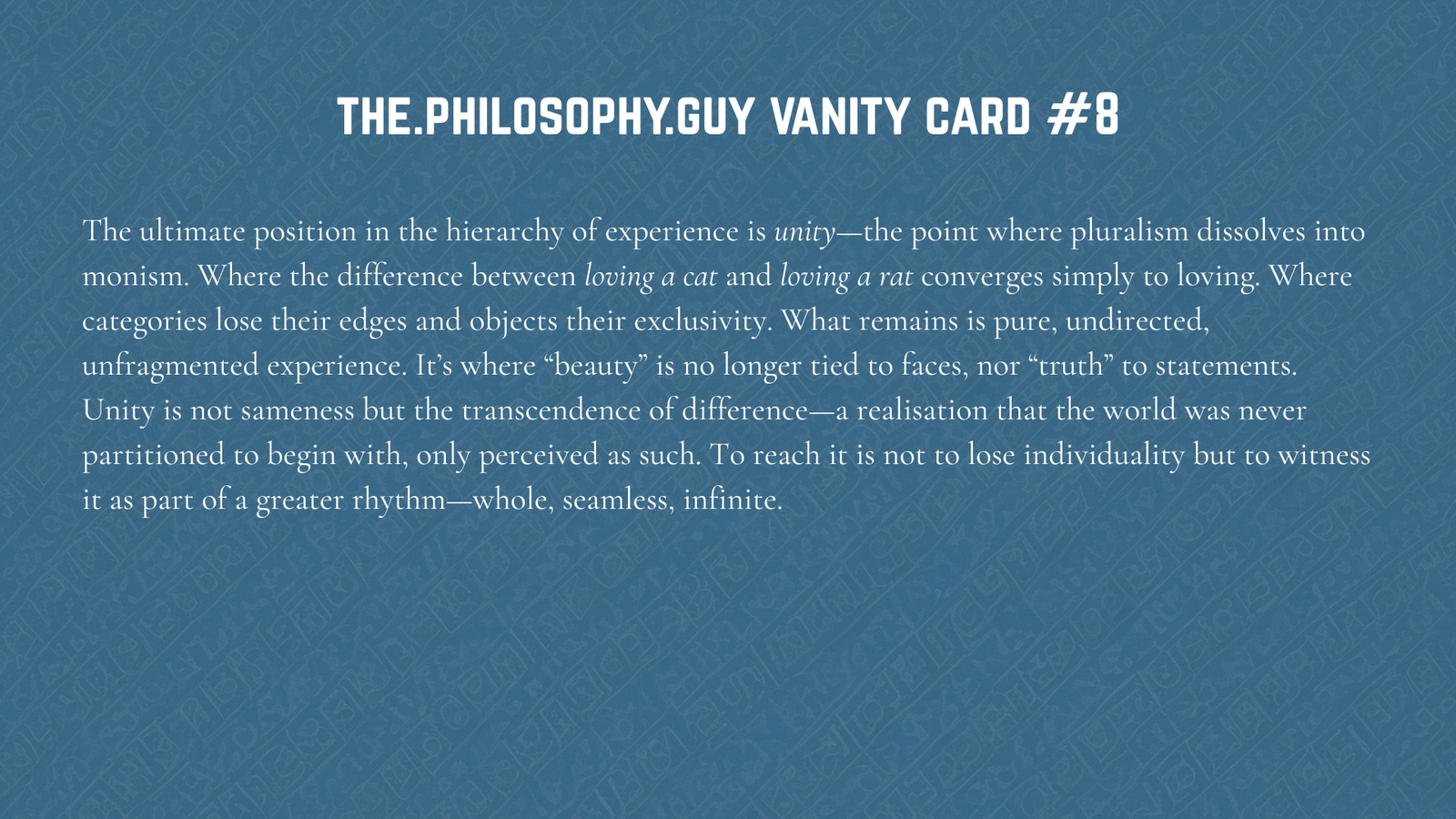
Q1) Do feelings converge? Is there a kind of monism underlying them all? Is love ultimately devoid of the apparent distinction between loving a cat and loving a rat, for example? I understand that in this non-utopian world, we might never be able to fully manifest the capital L Love. Loving the rat may simply mean losing the cat. To the cat, you’re no longer on her side. But does it exist?
Q2) If conscious experience is isomorphic across simulations, are we as indifferent to God as CJ from GTA is to us? For that matter, are we not similarly indifferent to a beggar? If this is true and conscious experience is all that ultimately matters, then what do we ultimately long for? What do we hook ourselves onto in order to find meaning? The experience itself? How?
Q3) When we talk about “X,” do we refer to a pre-identified notion, or do we appeal to a definition? Consider love. What did you just consider? The notion of liberation that philosophers talk about, or the notion of bondage that psychologists often describe—the commitment to wake up beside your partner every morning despite conflicts? If you considered one, why not the other? One might reply that love is simply defined that way. But then another question arises: what licenses that definition? How do we know it refers to anything at all? If it were only about definitions, what if I defined love as “averbiybvsdg!” So definition alone cannot explain meaningful thought. And yet somehow we seem capable of referring to something even before we settle on what it is.
Q4) Is the plurality of questions an artifact of human language? Consider the above-mentioned question. One might argue that, at its core, it is the same question as mathematical naturalism versus Platonism: whether abstract entities exist independently or merely as tools we employ. I can recognize that common essence because my language permits me to. But what if two questions appear entirely unrelated? Could they nonetheless be expressions of the same underlying question—one that could be rendered in a language, even if it might appear alien to us? Basically, can there exist The language?
Q5) If an ultimate formal system is insufficient to ascertain its own legitimacy, what grants it if not God? What grounds objectivity—not in the shallow, instrumental sense, but in the deeper, innate sense—if not God? What grounds change if not God? What grounds awareness if not God? As C. S. Lewis argued, if physicalism were true, we would not be able to reason into physicalism. What grounds reason itself if not God? How do atheists even have a case? Am I missing something here? You don’t have to know who He is in order to know that He is!
MY PHOTOGRAPHY